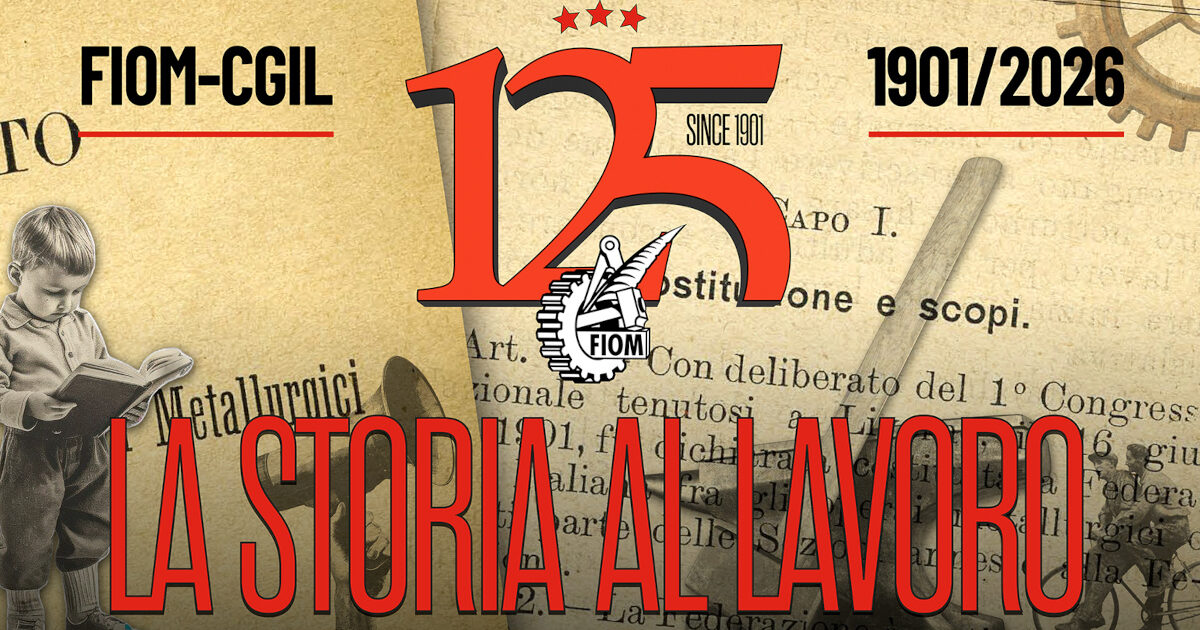
One hundred and twenty-five years ago today, 82 metal workers, guests, and allies gathered in the city of Livorno to found the Federazione Impiegati Operai Metallurgici (Federation of Metalworkers), Italy’s militant metalworkers’ union, which, over the past eleven years, has become one of UE’s closest international allies.
UE General President Scott Slawson sent a letter to FIOM General Secretary Michele De Palma congratulating FIOM on their anniversary. In his letter, Slawson writes,
Since your founding convention on June 16, 1901 in Livorno, FIOM has been a strong and militant voice for Italy’s metalworkers. In addition to fighting for rights, wages, and safety in the workplace, FIOM has struggled valiantly for democracy, dignity, and social justice. The oldest and most representative industrial union in Italy, FIOM has been the political conscience of the working class. FIOM has always been on the side of workers and against fascism, fighting for an Italy founded on labor and not capital.
UE’s relationship with FIOM initially developed out of efforts to build solidarity among General Electric workers worldwide. (UE had a national contract with GE from 1937 until 2019, when GE sold its locomotive plant in Erie, Pennsylvania — the last remaining UE shop at GE — to Wabtec.) A FIOM delegation, including two GE workers, attended the 2015 UE convention, and FIOM was a key partner in setting up a global trade union network at GE in 2018, a process that UE spearheaded.
FIOM also sent delegations to the 2017 and 2019 UE conventions, and video greetings to the 2021, 2023, and 2025 conventions. UE Staff Coordinator John Thompson, then an International Representative and secretary of the GE Conference Board, attended FIOM’s 27th Congress in 2018. “Any UE member would have felt right at home at the Congress, where rank-and-file delegates spoke throughout the four-day-long gathering,” Thompson told the UE NEWS.
In 2022, UE hosted a FIOM delegation in Chicago on May Day, where FIOM members placed a new plaque on on the Haymarket Square monument, and in 2024 FIOM and UE members participated in an exchange at that year’s Labor Notes conference, also in Chicago.
Like UE, FIOM often faced suppression by the government. In the year before its founding, the government had attempted to outlaw the labor movement in Genoa, claiming it was led by “subversives.” A general strike, led by metal workers, forced the government to back down. In 1924, Mussolini’s Fascist government banned independent trade unions. Speaking to what would be the union’s last congress for two decades, FIOM General Secretary Bruno Buozzi declared, “Even if all our achievements were physically destroyed, a single moment of freedom would suffice to make them flourish again, better than before.”
Buozzi, who went on to play an important role in the Italian Resistance, was executed by Nazi troops in June 1944, but days after his murder his prediction came true with the founding of the Italian General Confederation of Labour (CGIL) in newly-liberated Rome. CGIL unions, like UE, united workers regardless of political affiliation, and FIOM-GCIL grew rapidly.
As the Cold War developed, the same red-baiting elements in the U.S. labor movement which attacked UE also sought to split European labor movements, as historian Jeff Schuhrke documented in his 2024 book Blue-Collar Empire. Although the cold-warriors, assisted by the U.S. government, were successful in provoking splits in the Italian labor movement, FIOM has remained the largest and most powerful metalworkers’ union in Italy, securing significant gains in their most recent negotiations with employers. The new contract provides for “a crucial victory that ensures long-term wage defense at a moment when many families are facing mounting financial strain,” along with gains in the fight against job insecurity and precarious (part-time and temporary) work, stronger health and safety protections, and new provisions specifically aimed at preventing violence against women.
Slawson concluded his letter to FIOM with the observation that “FIOM is, like UE, a union that is committed to aggressive struggle and to uniting the workers of the world. Long live FIOM! Long live international solidarity!”
Read more about the founding of FIOM on their website (article is in Italian, but there is an option, supported by most browsers, to translate into English).